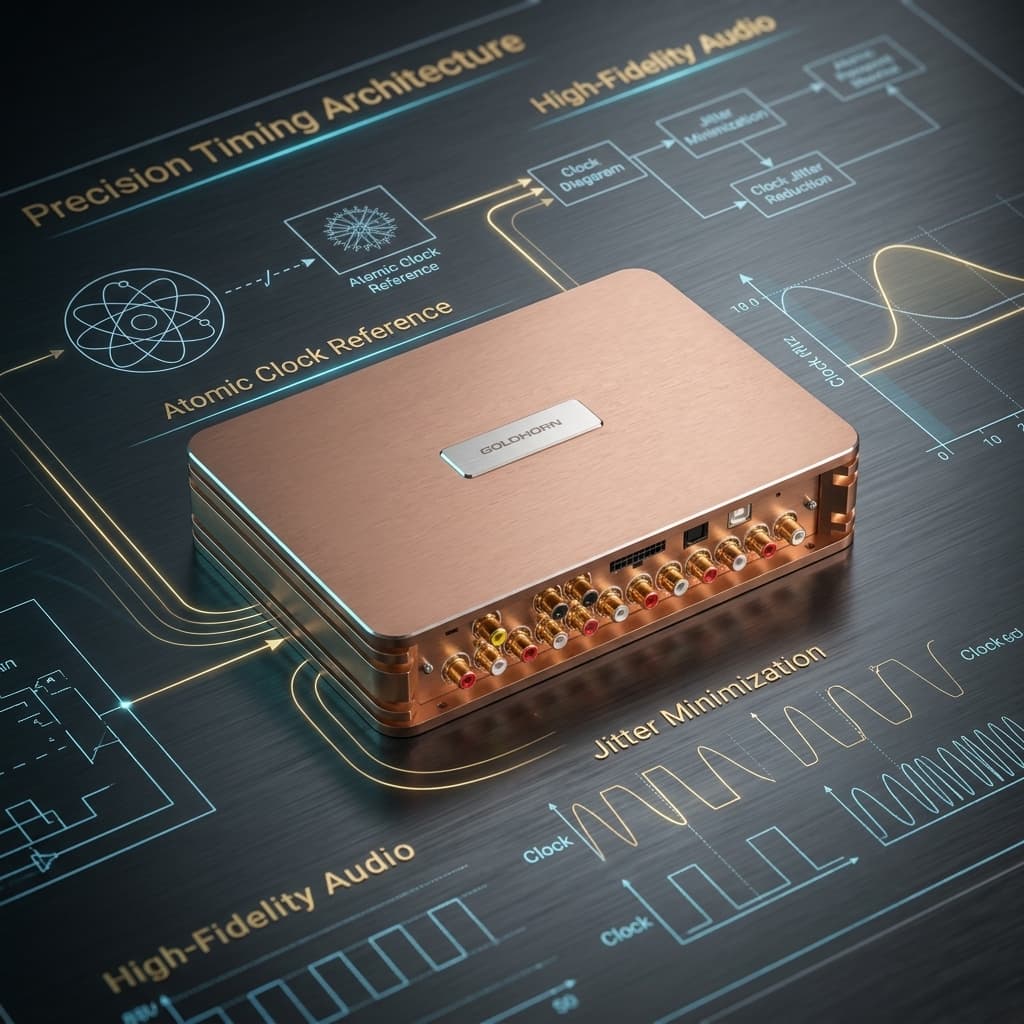
The Silent Enemy of Digital Audio: Digital Jitter
In the pursuit of high-fidelity car audio, enthusiast attention is often directed to raw power: massive amplifiers, premium speaker cones, and complex sound deadening. However, in modern high-resolution digital playback systems, the most critical component determining the realism and precision of the soundstage is completely invisible: the digital clock. Without an ultra-precise timing reference, even the most expensive Digital-to-Analog Converter (DAC) chips fail to deliver their theoretical potential.
Understanding Jitter and Time-Domain Distortion
Digital audio files are composed of a series of discrete numbers (samples) that represent the sound wave. During playback, these samples must be converted back to a continuous analog waveform by the DAC. To do this accurately, the DAC requires a master clock oscillator to tell it exactly when to convert each digital sample into an analog voltage.
In a perfect world, these samples are converted at exactly equal time intervals. In reality, fluctuations in clock timing occur. This fluctuation on the time axis is called digital jitter (usually measured in picoseconds or femtoseconds). When the master clock fluctuates, even by a fraction of a nanosecond, the timing of the conversion deviates from the original recording. This timing error translates directly into amplitude distortion in the analog output, known as time-domain distortion.
Instead of a clean, coherent reconstruction of the sound wave, jitter introduces micro-timing discrepancies. These discrepancies manifest as high-frequency harshness, loss of subtle acoustic details (such as the decay of a cymbal or the acoustics of the recording room), and a smeared, unstable stereo image. When jitter is high, instrument locations on the virtual soundstage become blurry and drift.
The Hostile Vehicle Environment
A vehicle's cabin is one of the most hostile environments for sensitive digital electronics. Traditional digital players rely on standard crystal oscillators to generate their clock signals. However, these standard crystals are highly sensitive to two major factors prevalent in vehicles:
- Thermal Fluctuations: Car interiors experience extreme temperature swings, from freezing winter nights to baking summer dashboards reaching over 70°C. Standard crystals drift significantly in frequency as temperature changes.
- Electromagnetic Interference (EMI) & Power Ripple: The alternator, ignition systems, and dozens of electronic control units (ECUs) in a modern car inject massive electrical noise into the vehicle's power grid. This noise bleeds into the clock circuits, compounding timing instability.
These environmental pressures introduce high amounts of jitter, meaning standard car audio sources suffer from significant time-domain distortion, destroying the potential of any downstream high-end speakers.
Enter Femtosecond Clocks: Ultimate Precision
To combat timing instability, high-end home audio equipment utilizes ultra-low phase noise clock generators known as femtosecond clocks. Goldhorn has pioneered the integration of this reference-level technology directly into the automotive domain.
A femtoseconde is one quadrillionth of a second (1 fs = 10-15 seconds). To put this in perspective, a femtosecond is to a second what a second is to approximately 32 million years. Crystal oscillators rated in the femtosecond range maintain a temporal grid of unmatched stability, keeping phase noise and jitter to a microscopic level.
By keeping timing variations to a minimum, femtosecond clocks virtually eliminate time-domain distortion. The DAC receives its timing cues on an incredibly rigid schedule, allowing it to reconstruct the analog waveform with surgical precision. This precision translates directly into reference-level acoustic imaging: the virtual soundstage snaps into sharp focus, instrument placements are rock-solid, and a true three-dimensional sense of space and depth is realistically recreated right above your dashboard.
Goldhorn's Flagship Implementations
Goldhorn implements these high-precision clock networks within its flagship players to isolate the digital-to-analog stage from vehicle noise and thermal drift:
- Goldhorn P5 DSP Ultra: The absolute crown jewel of the Goldhorn lineup utilizes 3x Femtosecond Clock Generators. Why three? Different high-resolution sample rates (multiples of 44.1 kHz, multiples of 48 kHz, and the CPU/DSP system processing clock) require different base frequencies. Utilizing a single clock and dividing it fractionally introduces jitter. By dedicating independent, ultra-precision femtosecond oscillators to the 44.1 kHz family (e.g., DSD, FLAC), the 48 kHz family (e.g., studio master files), and the digital processing stage, the P5 DSP Ultra ensures that every audio format is reconstructed natively with perfect timing. Combined with dual ES9038Pro DAC chips and triple ADAU1463 DSPs, it represents the absolute pinnacle of car audio resolution. Learn more about the Goldhorn P5 DSP Ultra.
- Goldhorn P2 DSP Pro V2.0: This high-end integrated source and DSP unit also inherits the triple-clock architecture, utilizing 3x Femtosecond Clock Generators. Paired with six ES9038Q2M DAC chips, it provides native DSD decoding and 12 channels of pristine RCA outputs, delivering a jitter-free, audiophile-grade soundstage in a more compact layout. Learn more about the Goldhorn P2 DSP Pro V2.0.
Conclusion: Timing is Everything
In high-fidelity car audio, achieving reference-level performance is no longer just about raw amplification power or speaker placement; it is about timing accuracy. By eliminating digital jitter at the source, Goldhorn's players equipped with femtosecond clocks ensure that your mobile listening cabin matches the depth, clarity, and precision of the finest home audiophile listening rooms.