The Challenge of Car Acoustics
The interior of a vehicle is one of the most hostile environments for high-fidelity audio. Between the drone of road noise, engine vibrations, highly reflective glass windows, and sound-absorbing leather or fabric seats, standard audio systems struggle to deliver a convincing soundstage. In such an acoustic environment, compressed audio formats like MP3 reveal their worst limitations, sounding flat and lifeless. This is why transitioning to high-resolution lossless audio formats—such as FLAC, WAV, and DSD—is a game-changer for car audio enthusiasts. However, to truly hear the difference, the signal must be decoded and processed by dedicated, high-end hardware.
Understanding the Formats: MP3 vs. FLAC vs. WAV vs. DSD
To understand why lossless audio makes such a significant difference in the car, we must look at how these formats store audio data:
- MP3 (Lossy Compressed): Designed in the 1990s, MP3 uses psychoacoustic compression to discard audio data that it assumes the human ear cannot perceive. While efficient for early internet streaming, it cuts out fine harmonics, dynamic range, and spatial cues. In a car cabin, this loss of detail results in a muddy bass response, recessed vocals, and a flat, narrow stereo image.
- FLAC (Lossless Compressed): FLAC compresses audio data without losing any original information. It acts like a ZIP file for audio, retaining 100% of the studio master's details while reducing file size by up to 60%. It supports resolutions up to 24-bit/192kHz, making it the perfect standard for high-fidelity listening.
- WAV (Lossless Uncompressed): Developed by Microsoft and IBM, WAV stores raw, uncompressed PCM audio. It offers identical quality to the studio master with zero CPU decompression overhead. However, the file sizes are massive, and without high-quality hardware, it is still subject to conversion inaccuracies.
- DSD (Direct Stream Digital): The pinnacle of audiophile formats. Unlike PCM-based formats (MP3, FLAC, WAV) that slice audio into multi-bit samples, DSD uses 1-bit Pulse-Density Modulation (PDM) at extremely high sampling rates (up to 11.2 MHz for DSD256). This continuous stream closely mimics an analog signal, delivering unmatched warmth, absolute micro-detail, and a holographic three-dimensional soundstage.
Format Specifications Comparison
| Format | Type | Max Resolution | Typical Bitrate | Car Acoustic Benefit | Hardware Required |
|---|---|---|---|---|---|
| MP3 | Lossy Compressed | 44.1 kHz / 16-bit | 320 kbps | Low (Flat soundstage, muddy detail) | Standard OEM Radio |
| FLAC | Lossless Compressed | 192 kHz / 24-bit | ~1,000 kbps | Medium-High (Good clarity, full dynamics) | Standard Head Unit / Basic DSP |
| WAV | Lossless Uncompressed | 192 kHz / 24-bit | 1,411 - 9,216 kbps | High (Accurate transients, wide stage) | Premium DSP / Goldhorn Source |
| DSD | 1-bit Delta-Sigma | 11.2 MHz (DSD256) | 5.6 - 22.5 Mbps | Ultra (Analog-like depth, zero jitter harshness) | Goldhorn P2 Pro / P3 Plus / P5 DSP Ultra |
Why the Car Environment Demands Lossless Audio
In a home listening room, the background noise is minimal. In a car, the noise floor is high, constantly masking subtle frequencies. Standard MP3 files, which have had their quiet details stripped away, get completely drowned out by road rumble, forcing you to turn up the volume to hear details, which leads to distortion and ear fatigue. Lossless formats, particularly DSD, preserve the full dynamic range. The transient response is sharp, allowing instruments like acoustic guitars, drum hits, and delicate vocals to cut through the road noise clearly and naturally, even at lower volumes.
The Bottleneck: Why Standard Car Radios Fail
Many car owners copy FLAC or DSD files onto a USB drive and plug it directly into their car's original infotainment USB port, only to be disappointed. Standard original equipment manufacturer (OEM) head units are built with budget-grade components. If they play high-res files at all, they downsample them to standard CD quality (48kHz/16-bit) and run them through cheap Digital-to-Analog Converters (DACs). These low-end DACs introduce significant jitter (timing errors in the audio clock). In the reflective, small cabin of a car, jitter manifests as high-frequency harshness and a smeared stereo image where you cannot point out where the singer is standing.
The Solution: Goldhorn's High-Resolution DSD Source Units
To experience the absolute depth of FLAC, WAV, and native DSD, you must bypass the vehicle's factory processing and use a dedicated audiophile-grade source unit with ultra-low-jitter clocks and high-end DACs. This is where Goldhorn's specialized range comes in:
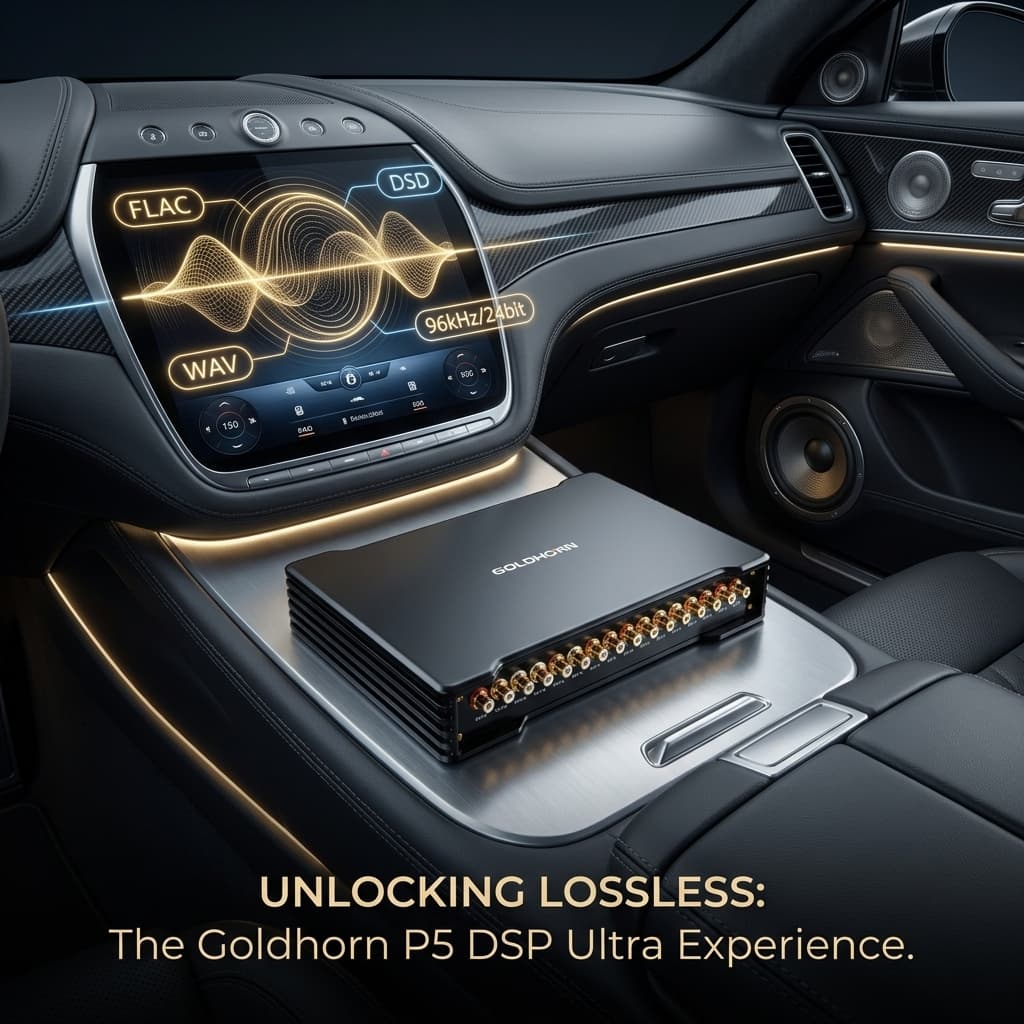
- Goldhorn P5 DSP Ultra: Our flagship all-in-one DSD player and digital signal processor. It is equipped with two flagship ESS Sabre ES9038Pro DAC chips, three ADI ADAU1463 DSP chips, and three high-precision Femtosecond clock generators. It decodes native DSD and high-res PCM formats with unmatched precision, completely eliminating jitter.
- Goldhorn P2 Pro: A mid-range pure DSD player designed for audiophiles who want a dedicated high-fidelity source. It features two Asahi Kasei AK4493 DAC chips, a custom-designed GHA1000 processing chip, and two femtosecond clock generators to deliver a pure, natural analog output.
- Goldhorn P3 Plus: A high-end pure digital audio source DSD player featuring the premium ESS Sabre ES9028Pro DAC chip. It functions as a pure digital transport and DAC, designed to feed external amplifiers or DSP systems without any signal degradation.
By integrating a Goldhorn source unit, you ensure that every bit of your high-resolution music library is preserved from the storage medium to the analog stage, yielding an incredibly detailed, emotional, and realistic listening experience inside your car.