Introduction: The Brains and the Brawn of Car Audio
The paradigm of car audio system design has shifted completely in 2026. In the early days, improving your vehicle's audio meant simply swapping out the head unit (the radio) and tossing in a pair of aftermarket speakers. In modern vehicles, however, the original equipment manufacturer (OEM) head unit is an un-swappable Command Center controlling navigation, climate settings, and ADAS features. To unlock true high-fidelity sound, we must work with the factory signal, and that requires a Digital Signal Processor (DSP). But as you plan your system, you face a major structural decision: Should you buy a Standalone DSP or an Integrated DSP Amplifier? Here is everything you need to know to make the correct choice.
What is a Standalone DSP?
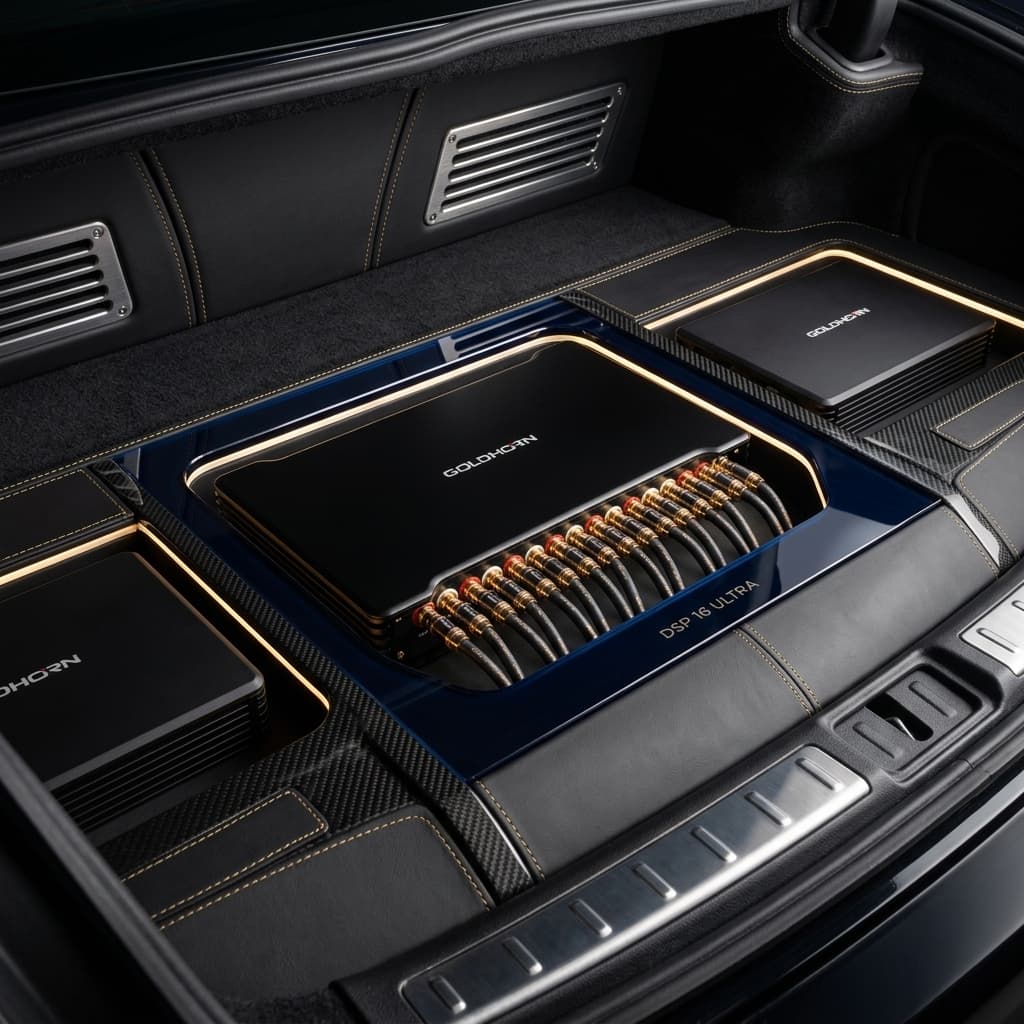
A Standalone DSP (such as the Goldhorn DSP10 or the reference-grade Goldhorn DSP16 Ultra) is a dedicated processor with no built-in power amplifier channels. Its sole task is to take the factory high-level or digital input signal, perform surgical acoustic corrections (time alignment, parametric EQ, and crossover filtering), and output a high-voltage, low-impedance analog signal via RCA to separate, external power amplifiers.
- The Pros: Maximum flexibility. Since the DSP is independent, you can choose the exact size, class, and brand of amplifier for each speaker group. High-end standalone units are built with superior hardware components, such as ESS Sabre DACs, since there are no space and thermal constraints from built-in amplifier stages.
- The Cons: High installation complexity. You need separate power, ground, and RCA interconnect cables for the DSP and every single amplifier, which takes up substantial space in your trunk or under-seat compartments.
What is a DSP Amplifier?
A DSP Amplifier (such as the flagship Goldhorn DSPA 2416 Ultra or the compact Goldhorn DSPA 1216 Plus) combines both the digital signal processor and a multi-channel power amplifier into a single, compact chassis. It intercepts the factory radio signal, processes it, and directly outputs amplified power to your car's speakers.
- The Pros: Incredible spatial efficiency and simplified wiring. You only need to run one main power and ground feed to the unit. Integration is often plug-and-play using vehicle-specific T-harnesses, allowing you to upgrade lease cars without cutting factory wires.
- The Cons: Fixed power limits. Because the amplifier channels share a power supply and a compact housing, they are typically limited to 80W RMS per channel. While perfect for tweeters, midranges, and standard woofers, it may not satisfy users who want extremely high-output midbass drivers or subwoofers (which require external monoblock amplifiers connected to the DSP Amp's processed RCA outputs).
The Head-to-Head Comparison
Power Limits & System Scalability
Integrated DSP Amplifiers are perfect for standard multi-channel setups, but they have inherent limits. While a unit like the Goldhorn DSPA 1616 Ultra provides 16 channels of 80W amplification, heavy midbasses or large subwoofers demand more power. A standalone DSP allows you to mix a delicate Class A/B amplifier for your tweeters with a powerful 1000W Class D monoblock for your subwoofers.
Wiring & Installation Complexity
For modern cars, a DSP amplifier is often the only realistic way to upgrade due to space constraints. Using a plug-and-play wiring harness, the DSP amplifier sits neatly under a seat or behind the dashboard. A standalone DSP setup requires a custom amp rack, complex wiring routing, and multiple power distribution blocks.
Audio Resolution & Component Quality
Because standalone processors do not have high-current amplifier stages sharing their PCB, they are less prone to electromagnetic interference (EMI) and heat build-up. Flagship standalone units like the Goldhorn DSP16 Ultra employ multiple high-end DACs (such as two ES9038Pro chips) and precise clock generators, delivering a lower noise floor and a wider dynamic range.
Budget & System Cost
If you are looking for the best performance-to-cost ratio, an integrated DSP amplifier wins hands down. To equal the 12 channels of the Goldhorn DSPA 1216 Plus using standalone gear, you would have to buy a DSP plus two or three separate amplifiers, resulting in double the cost.
Which Setup is Right for You?
Choose a Standalone DSP if:
- You are aiming for competition-level sound quality where space and cost are secondary.
- You already own high-quality external amplifiers that you want to reuse.
- You need customized high-power configurations (e.g. 200W+ RMS for midbasses).
Choose a DSP Amplifier if:
- You are upgrading a modern vehicle's factory system while keeping the OEM look.
- You want a clean, hidden installation with minimal wiring.
- You are looking for the best value per channel of processing and amplification.
Goldhorn Product Comparison
| Model | Type | DSP Channels | Amp Channels | Power Output (4Ω) | DAC / Processor |
|---|---|---|---|---|---|
| DSP10 | Standalone DSP | 10 Channels | None | - | ADAU1452 |
| DSP16 Ultra | Standalone DSP | 16 Channels | None | - | 3x ADAU1463 + 2x ES9038Pro |
| DSPA 1216 Plus | DSP Amplifier | 16 Channels | 12 Channels | 12x 80W (Bridged: 6x 200W) | ADAU1452 |
| DSPA 1616 Ultra | DSP Amplifier | 16 Channels | 16 Channels | 16x 80W | ADAU1463 |
| DSPA 2416 Ultra | DSP Amplifier | 24 Channels | 24 Channels | 20x 80W + 4x 150W | 2x ADAU1463 (SKYATOM) |
DSP16 Ultra
The ultimate pure audio brain featuring three ADAU1463 processors and dual ESS ES9038Pro DAC chips for zero-compromise acoustic precision.
DSPA 2416 Ultra
A multi-channel monster providing 24 channels of DSP control and Class D amplification, pushing up to 150W per channel on sub channels. Features SKYATOM surround sound.
DSPA 1616 Ultra
An ideal integrated choice for full active 3-way setups. 16 channels of premium Class D amplification with 80W per channel for complete coverage.