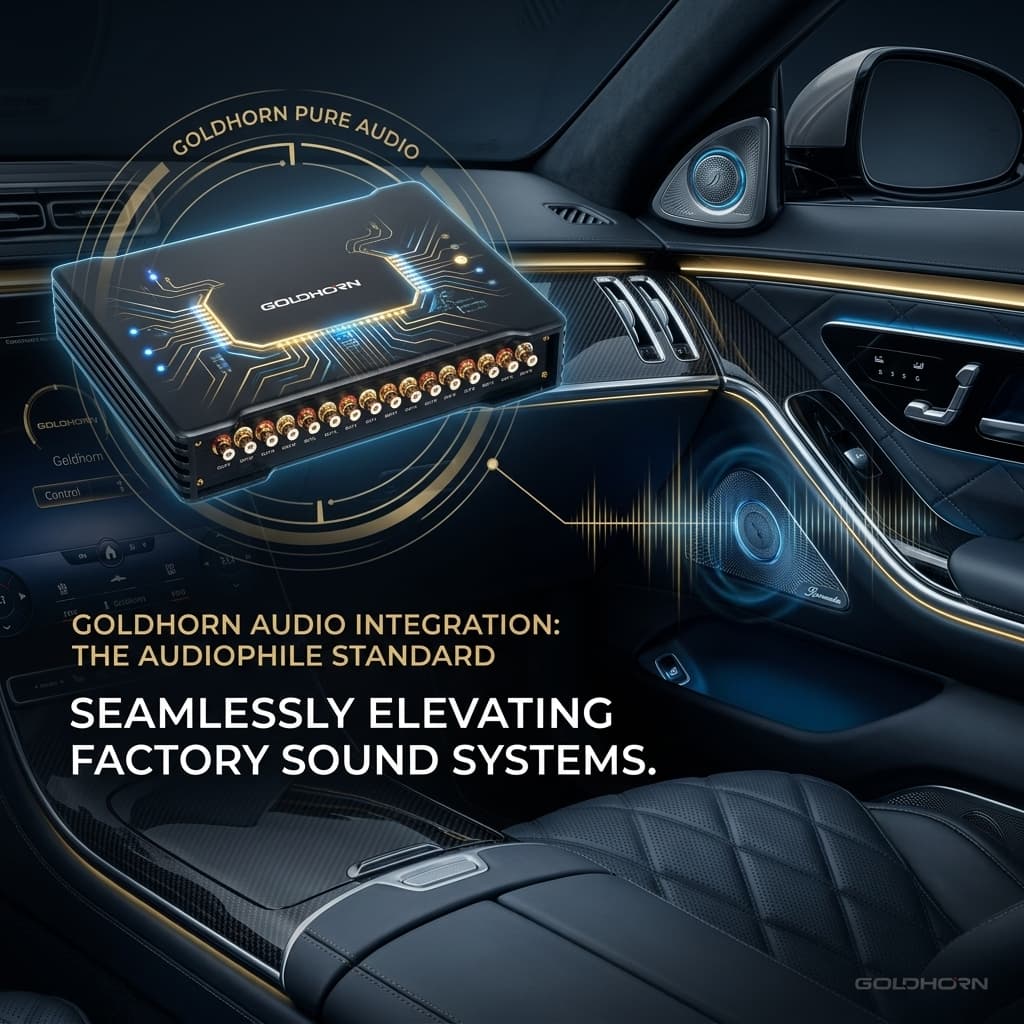
Introduction: The Illusion of Premium Factory Sound
When purchasing a luxury vehicle from brands like Mercedes-Benz, BMW, or Audi, opting for the premium sound system package (such as Bose, Burmester, or Harman Kardon) seems like a guarantee of audio perfection. However, car audio enthusiasts and professional installers know a frustrating truth: these systems often fall short. To save costs and weight, vehicle manufacturers still use cheap paper-cone speakers driven by complex, highly equalized factory amplifiers. When you try to upgrade the speakers or add a subwoofer, you run into the digital wall of modern automotive architecture. Upgrading these premium systems requires understanding how they process audio and how Goldhorn's advanced multi-channel DSP Amplifiers and MOST integration modules can solve these issues.
The Core Challenge: Active Crossovers and Signal Summing
In standard car audio systems, the radio outputs a full-range analog signal (from 20 Hz to 20,000 Hz) to the speakers. Upgrading is simple: you intercept the signal and run it to an amplifier. Premium factory systems do not work this way. The factory amplifier acts as a crossover network. It splits the audio signal into narrow frequency bands before amplification. For example, in a Burmester system, the tweeters in the doors might only receive frequencies above 4,000 Hz, the midranges receive 250 Hz to 4,000 Hz, and the woofers handle the low end below 250 Hz.
If you connect a standard aftermarket amplifier to the tweeter wires, you will only get high-pitched treble. To get a full-range signal for your new sound system, you must intercept the signals from the tweeters, midranges, and woofers, and merge them back together. This process is called Signal Summing. However, simply combining these wires electrically causes phase cancellation and acoustic interference, resulting in massive dips in your frequency response where vocals or instruments disappear completely.
Aggressive OEM EQ and Time Alignment
Even if you sum the signals, you face another hurdle: Factory Equalization (EQ) and Time Alignment. Premium amplifiers apply heavy EQ curves designed to correct the acoustic flaws of the cheap factory speakers and the car's interior. They also apply time delays so the sound from the left speaker reaches the driver at the same time as the right speaker. If you feed this pre-distorted signal into high-end aftermarket speakers, the result will sound harsh and unnatural. To solve this, you need a processor that can analyze the factory signal, measure the built-in time delays, and reverse-engineer the EQ to create a completely flat, neutral output. This process is known as De-Equalization (De-EQ).
The Goldhorn DSP Solution: Intelligent Summing and De-EQ
Goldhorn’s flagship multi-channel DSP amplifiers, such as the DSPA 2416 Ultra and DSPA 1616 Ultra, are designed specifically to handle the complex summing and de-equalization required for premium system upgrades. These units feature up to 16 or 24 channels of processing and high-level inputs, allowing them to capture every single channel from the factory amplifier.
- Phase-Corrected Summing: Goldhorn's DSP software allows installers to adjust the input delay and phase of each incoming channel before summing. This ensures that the high, mid, and low frequencies merge perfectly without phase cancellation.
- Input RTA & De-Equalization: Using the built-in Real-Time Analyzer (RTA), the DSP analyzes the factory EQ curve and automatically applies a corrective, inverse EQ curve to flatten the signal. The result is a clean, full-range canvas ready for tuning.
The Premium Shortcut: MOST Fiber-Optic Integration
While high-level signal summing is highly effective, there is an even cleaner, higher-fidelity method for vehicles that use fiber-optic communication networks. In premium sound systems from BMW, Mercedes-Benz, Porsche, and Land Rover, the head unit sends audio data to the factory amplifier digitally using a MOST (Media Oriented Systems Transport) fiber-optic ring (MOST25 or MOST150).
Instead of letting the factory amplifier process and distort the signal, and then attempting to sum and clean it up, Goldhorn's OEM integration modules allow you to intercept the audio while it is still in the digital domain. A digital MOST integration interface plugs directly into the fiber-optic network, extracting the raw, untouched digital stereo audio stream and converting it into a standard Toslink optical or coaxial digital output.
This approach offers several massive advantages:
- Zero Distortion: Because the signal never goes through the factory amplifier's D/A converters, analog summing, or OEM equalization, there is zero added noise, distortion, or phase issues.
- High-Resolution Audio: You get a pure digital stereo signal, delivering the absolute highest audio resolution directly to your Goldhorn DSP or DSP Amplifier.
- Full OEM Control: The factory steering wheel volume controls, balance, fader, and warning chimes are preserved and communicated seamlessly through the Goldhorn interface.
Choosing the Right Path for Your Upgrade
When planning your premium system upgrade, the choice between high-level summing and MOST digital integration depends on your vehicle and system design:
| Feature | High-Level Summing (DSP Amp) | MOST Digital Integration |
|---|---|---|
| Signal Processing | Analog capture & digital correction (De-EQ) | Direct digital extraction (Pure signal) |
| Noise Floor | Low (subject to factory amp noise) | Zero (completely silent background) |
| Wiring Complexity | Moderate (splice/plug into multiple speaker lines) | Very Low (plug-and-play fiber optic loop) |
| Supported Vehicles | All vehicles (universal high-level inputs) | Specific BMW, Mercedes-Benz, Porsche, Audi models |
Goldhorn Premium Integration Products
DSPA 2416 Ultra
The ultimate 24-channel DSP amplifier for high-end multi-speaker systems. Easily sums up to 16 high-level inputs with active phase alignment and automatic de-equalization.
DSPA 1616 Ultra
A powerhouse with 16 channels of Class D amplification and 16 DSP channels. Perfect for active 3-way setups that require input summing and corrections.