Upgrading Factory Car Audio: Navigating OEM Integration, ANC, and Impedance Sensing
In modern car audio design, the days of simply removing the factory radio (head unit) and replacing it with an aftermarket stereo are long gone. In 2026, the vehicle's infotainment system acts as the central nerve center, controlling everything from air conditioning and vehicle settings to diagnostics, navigation, and warning chimes. Removing this screen is simply not an option. However, factory sound systems are notorious for their lack of power, muddy frequency response, and cheap speakers.
To upgrade these systems while retaining the original dashboard appearance, installers must employ OEM Integration. This process requires interfacing with high-level speaker signals, employing vehicle-specific T-Harnesses, and addressing advanced electronic systems like factory diagnostics (impedance sensing) and Active Noise Cancellation (ANC). Here is how Goldhorn's advanced technologies make this integration seamless and error-free.
Understanding High-Level Signals and T-Harnesses
Unlike aftermarket radios that feature clean, unamplified RCA preamp outputs (low-level signals), factory head units output amplified high-level signals directly to the speakers. Connecting these high-voltage signals to a traditional aftermarket amplifier will cause input clipping, high distortion, or even hardware failure.
Modern DSP amplifiers, such as the Goldhorn DSPA-1012 Plus or the Goldhorn DSPA-810 Pro V2, are engineered to accept high-level inputs with high voltage tolerances (often up to 10V or 20V RMS). This allows the processor to take the factory speaker signal, step it down cleanly, and convert it back to a high-fidelity digital format for processing.
To capture these signals without altering the vehicle's factory wiring harness, installers use vehicle-specific T-Harnesses. These plug-and-play harnesses insert directly between the factory head unit and the car's wiring. By routing the signals out to the DSP amplifier and sending the newly amplified channels back through the factory wiring to the speakers, T-Harnesses provide a non-destructive installation. This is particularly crucial for lease vehicles or cars still covered under factory warranty, as the entire upgrade is 100% reversible.
Impedance Sensing & Goldhorn's Error Protection System (EPS)
Modern vehicle diagnostic systems (found in brands like BMW, Mercedes-Benz, Volkswagen, and Audi) perform speaker diagnostics upon startup. The head unit sends a tiny electrical pulse to measure the impedance (resistance) of the connected load. Under normal circumstances, it expects to see a speaker impedance of 2 to 8 ohms.
When you disconnect the factory speakers and route the head unit's output to the high-impedance inputs of an aftermarket processor or amplifier (which usually have an input impedance of 10k ohms or higher), the car's diagnostic computer assumes the speaker circuit is open (blown or disconnected). To protect itself, the head unit will shut down the affected audio channels, trigger error codes in the vehicle diagnostics, or mute the audio system entirely. Crucially, this can also disable safety warning chimes, such as Park Distance Control (PDC) sensor sounds, seatbelt warnings, and navigation prompts, which are played through the factory speakers.
To solve this, Goldhorn developed the Error Protection System (EPS). EPS is an integrated resistive load simulation circuit. When the factory head unit performs its diagnostic check, the EPS circuit simulates a proper, low-impedance speaker load. The vehicle's computer detects a healthy load, boots up normally, and keeps all audio channels and warning chimes (PDC) fully operational without throwing any error codes.
Coexisting with Active Noise Cancellation (ANC)
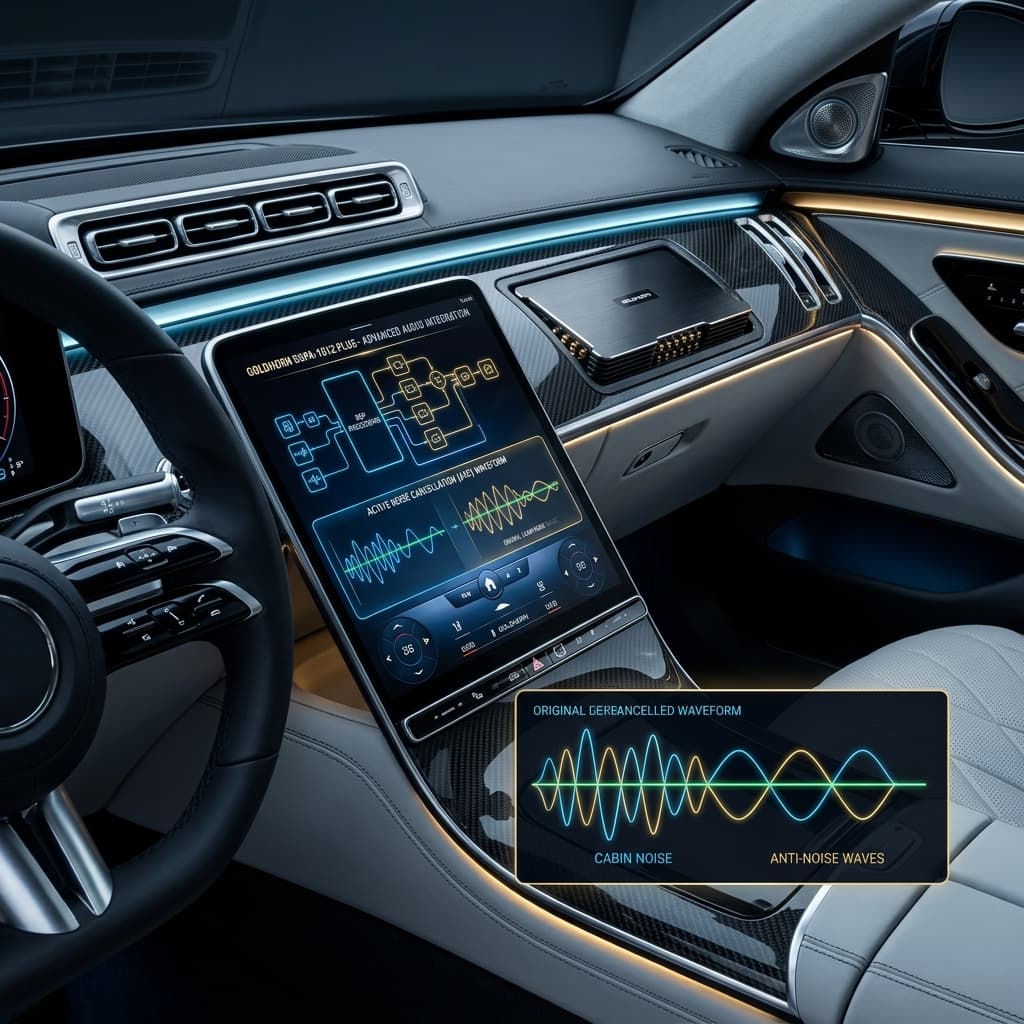
Another major hurdle in modern vehicle cabins is Active Noise Cancellation (ANC). Many vehicles utilize microphones built into the headliner to monitor low-frequency cabin noise (such as road noise, tire roar, and engine hum). The vehicle's audio computer then generates an out-of-phase "anti-noise" signal and plays it through the speakers to cancel out the cabin noise, creating a quieter ride.
However, when you upgrade the audio system with a high-power amplifier and a DSP, the gain, phase, and frequency response of the speaker outputs are altered. Because the aftermarket system is much louder and has modified phase characteristics, the ANC feedback loop becomes unstable. The result is a loud, low-frequency feedback loop—a continuous howling, roaring, or thumping sound in the cabin. Historically, installers had to physically locate and unplug the ANC microphones, disabling the factory noise cancellation feature entirely.
Goldhorn's advanced DSP amplifiers and proprietary firmware offer a sophisticated solution. Instead of disabling the microphones, Goldhorn's software allows installers to precisely align the phase, manage signal routing, and apply high-resolution digital filtering to co-exist with the vehicle's ANC system. By keeping the factory ANC signals isolated or properly phase-aligned, you can enjoy audiophile-grade music reproduction while keeping the factory quiet-cabin technology fully intact.
Conclusion: The Goldhorn Advantage
Upgrading modern car audio is not just about choosing the best-sounding speakers; it is about respecting the vehicle's digital architecture. By combining high-level signal handling, non-destructive T-Harnesses, impedance-matching EPS technology, and ANC-compatible firmware, Goldhorn allows you to unlock true high-fidelity sound. Explore our range of OEM Integration modules and discover how a professional integration preserves your vehicle's features while elevating your acoustic experience.