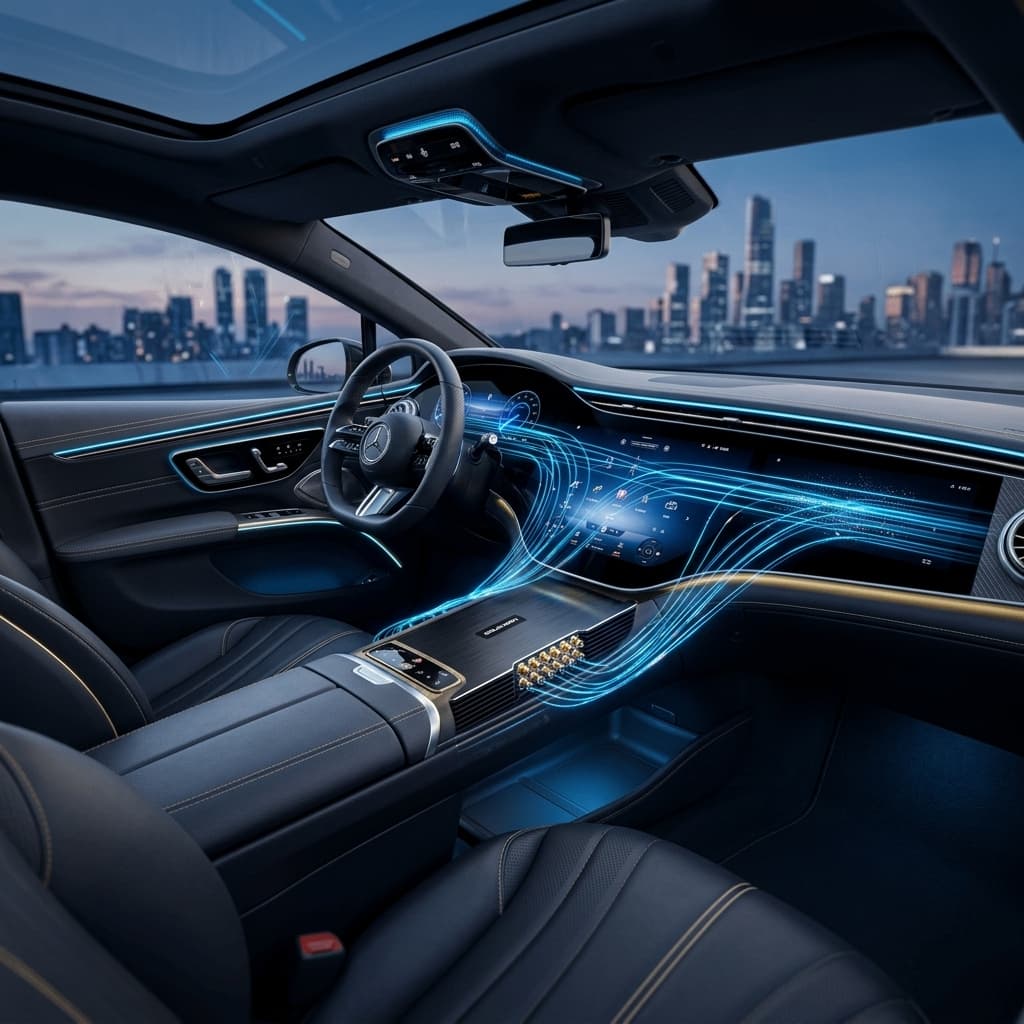
Why Traditional Audio Upgrades Fail in Modern EVs
Modern electric vehicles (EVs) from manufacturers like Tesla, BYD, Volvo, Li Auto, and XPeng have revolutionized transport, but they have also completely changed the rules of car audio upgrades. Traditionally, upgrading a sound system involved tapping into the analog speaker signals coming out of the factory amplifier and routing them to a Line Output Converter (LOC) or digital signal processor (DSP). In modern vehicles, this analog method is no longer viable for three main reasons:
- Factory DSP Processing: The OEM amplifier applies aggressive equalization curves, crossovers, and time delays tailored specifically for the cheap, factory-fitted speakers. Attempting to de-equalize or reverse this tuning results in phase issues and a degraded sound stage.
- Active Noise Cancellation (ANC): Modern EVs rely heavily on cabin microphones to measure road noise and output anti-noise through the speakers. Splicing into the analog outputs can disrupt this loop, leading to a loud, annoying low-frequency hum or acoustic feedback.
- Safety Alerts & Chimes: Driving assistance warnings, navigation prompts, and parking sensor sounds are routed digitally. Intercepting the signals post-amplifier can lead to lost, muted, or dangerously unbalanced system alerts.
What is A2B (Automotive Audio Bus)?
Developed by Analog Devices, Automotive Audio Bus (A2B) is a high-bandwidth, bidirectional digital bus that delivers high-fidelity audio, control data, clock, and power over a single, unshielded twisted-pair (UTP) cable. By replacing heavy, copper-analog speaker wires with a single lightweight digital line, car manufacturers reduce vehicle weight and improve manufacturing efficiency. However, because the entire audio ecosystem resides in this proprietary digital network, it effectively locks out traditional aftermarket amplifiers.
The Costly Workaround: Third-Party Converters
Until recently, the only way for installers to access a clean audio signal in A2B vehicles was to buy an external digital interface or converter (such as the NAV-TV ZEN-A2B). This device connects to the factory A2B bus and extracts a digital optical (TOSLINK) or coaxial output. While effective, it introduces several problems:
- High Cost: These converters are single-purpose boxes that typically cost over €750 / $700, drastically increasing the budget of any audio upgrade.
- Installation Complexity: They require additional wiring, separate power connections, and take up extra space, which is already extremely limited in compact EVs.
- More Failure Points: Adding more boxes, fiber-optic lines, and power runs increases the risk of component failures, diagnostic issues, and ground loops.
The Goldhorn Breakthrough: Native A2B Integration
Goldhorn has eliminated this complexity by developing the industry's first DSP amplifiers with a built-in, native A2B transceiver. The Goldhorn AB212 and AB218 connect directly to the vehicle's factory A2B bus. There is no need for external converter boxes, separate power supplies, or complex optical wiring.
By interfacing directly with the digital stream, Goldhorn A2B DSP amplifiers offer unmatched benefits:
- Bit-Perfect Digital Quality: They capture the raw, uncompressed digital audio signal directly from the infotainment system before any factory amplifier processing occurs.
- Cost-Efficient & Clean: Bypassing the need for a separate NAV-TV converter saves you hundreds of euros and ensures a much cleaner, more compact install.
- Full OEM Preservation: They seamlessly integrate with the car's network, keeping all Active Noise Cancellation (ANC), warning chimes, steering wheel controls, and factory microphone functions working perfectly with zero dashboard error codes.
- High-End Processing: Powered by premium Analog Devices ADAU1463 DSP processors and high-power Class D amplification, they deliver an audiophile-grade listening experience.
Explore the Goldhorn A2B Range
Choose the model that best fits your vehicle configuration and amplification needs:
Technical Specifications Comparison
| Specification | Goldhorn AB212 | Goldhorn AB218 |
|---|---|---|
| DSP Processor | 1x Analog Devices ADAU1463 | 2x Analog Devices ADAU1463 |
| Amplifier Class | Class D | Class D |
| Power Output (4Ω) | 8x 50W + 4x 100W | 12x 50W + 4x 100W |
| DSP Channels | 20 Channels | 16 Channels |
| Digital Inputs | A²B Digital Bus, Bluetooth 5.0 | A²B Digital Bus (OEM), Optical, BT 5.0 |
| RCA Outputs | 12 Channels | 16 Channels |
| S/N Ratio | ≥105dB | ≥110dB |
| Vehicle Support | Tank 300/500, Select BYD | BYD, Li Auto, Zeekr, XPeng |
| Dimensions | 240mm x 160mm x 48mm | 280mm x 190mm x 50mm |
Conclusion
Upgrading the sound system in a modern EV doesn't have to mean compromising on factory features or spending thousands on separate interface boxes and amplifiers. Goldhorn's native A2B DSP amplifiers represent the future of EV car audio integration, providing a direct, clean, and cost-effective digital path to audiophile performance. By keeping all OEM systems fully operational while unlocking the true potential of your speakers, the AB212 and AB218 set a new industry benchmark for premium EV audio upgrades.