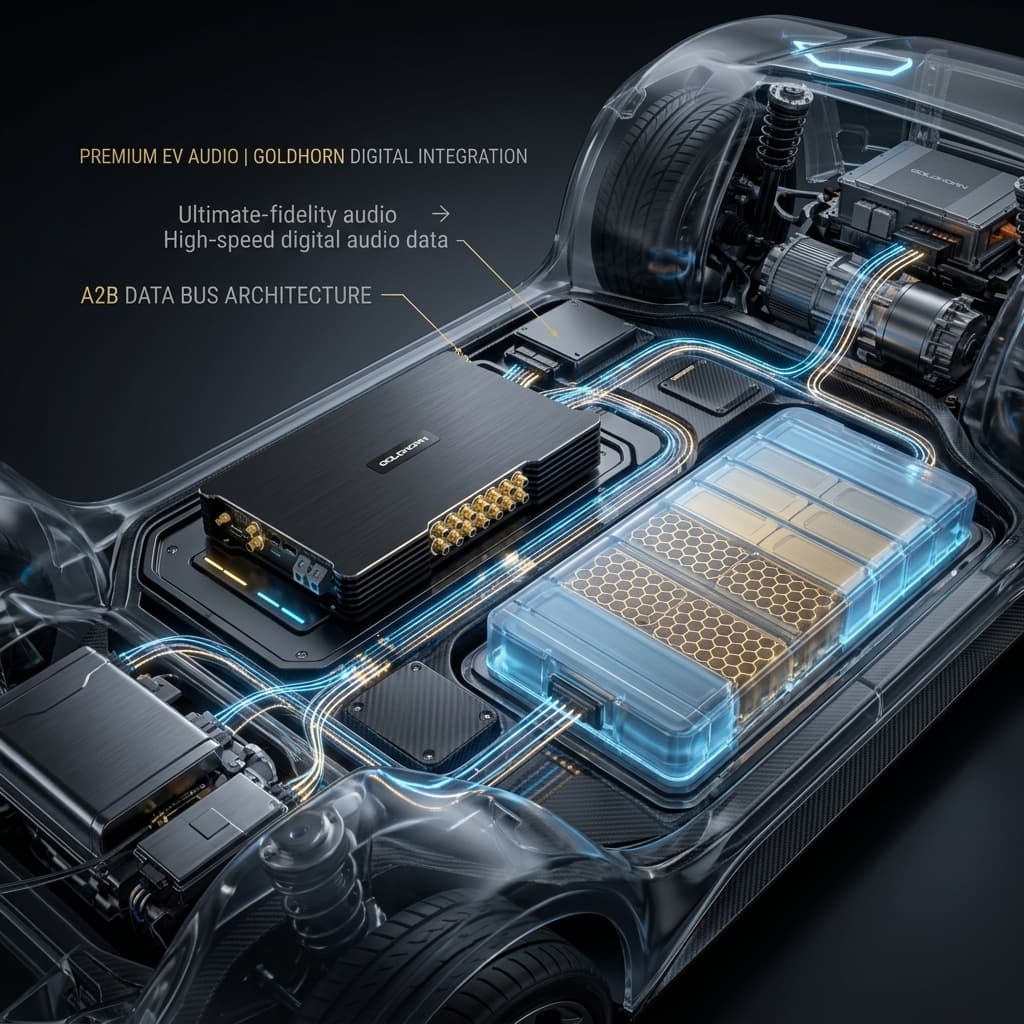
The EV Audio Dilemma: Range vs. Sound Quality
As electric vehicles (EVs) dominate the automotive landscape, car audio enthusiasts face a new set of challenges. Unlike traditional internal combustion engine (ICE) vehicles, where an alternator dynamically generates electricity, an EV relies entirely on its stored battery power. To maximize driving range, EV manufacturers design every component with extreme weight reduction and aerodynamic efficiency in mind. In this context, installing a traditional, power-hungry aftermarket audio system can negatively impact both range and vehicle stability if not approached with modern, specialized technology.
The Power Struggle: 12V/16V Auxiliary Systems and DC-DC Converters
A common misconception is that aftermarket car amplifiers draw power directly from the high-voltage (HV) traction battery pack (typically 400V to 800V). In reality, all auxiliary vehicle electronics—including the infotainment system, lighting, climate control, and audio equipment—run off a separate low-voltage auxiliary system. This is usually a 12V lead-acid/LiFePO4 battery, or in newer vehicles like Tesla, a 15.5V or 16V lithium-ion battery.
This auxiliary battery is kept charged by a DC-DC converter drawing power from the main HV traction pack. However, these DC-DC converters have strict current limits (often capped between 100A and 150A total for all vehicle systems). Traditional, inefficient amplifiers can draw massive transient currents (e.g., during heavy bass hits), exceeding the DC-DC converter's capacity. This leads to voltage sags on the auxiliary rail, which can trigger system error codes, disable driver-assistance features, or even cause the EV to enter a safety shutdown mode.
The Weight Factor: Heavy Copper Cables vs. Lightweight Alternatives
Every extra kilogram in an EV translates directly to reduced range, especially during stop-and-go city driving. Traditional multi-channel car audio systems require heavy copper power runs (such as 0-gauge or 4-gauge cables) running from the battery to the trunk, along with thick analog speaker wire bundles for every single channel. In a 12-channel system, this copper cabling alone can add 5 to 10 kilograms of dead weight to the vehicle. Minimizing this wiring weight is a crucial part of any professional EV audio upgrade strategy.
The Class-D Revolution: Redefining Amplification Efficiency
To overcome the strict power constraints of EVs, Class-D amplifiers are an absolute necessity. Traditional Class-AB amplifiers are notoriously inefficient, converting only about 50% of the electrical energy into audio power, while the other 50% is wasted as heat. This requires large, heavy aluminum heat sinks and draws twice the current from the auxiliary battery.
In contrast, modern Class-D amplifiers operate at over 90% efficiency. Because they turn transistors fully on or fully off rapidly rather than operating them in their linear region, they generate very little heat and draw significantly less current for the same audio output. This high efficiency allows for a much smaller chassis, lighter weight, and a drastically reduced thermal footprint, making them ideal for the tight, unventilated spaces in modern electric vehicles.
Goldhorn's A2B DSP Amplifiers: The Ultimate EV Solution
Goldhorn has pioneered the future of EV audio integration with their range of integrated A²B (Automotive Audio Bus) DSP Amplifiers, specifically the AB212 and AB218. These units combine an advanced Digital Signal Processor (DSP) and high-efficiency Class-D amplification into a single, compact chassis, but their true superpower lies in their native A²B bus integration.
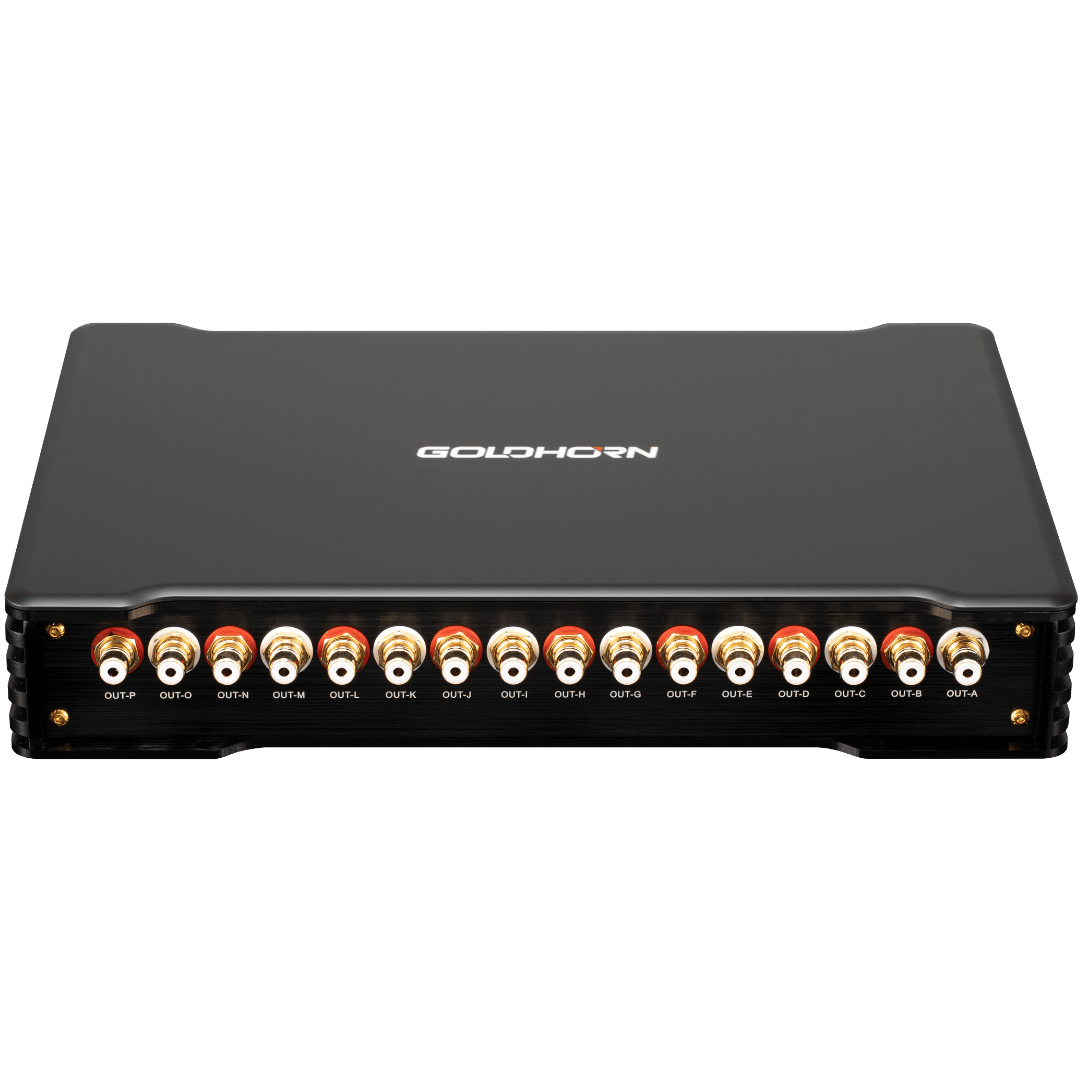
Goldhorn AB212
A²B DSP Amplifier featuring 1x ADAU1463 DSP chip, delivering 8x 50W + 4x 100W output with high-efficiency Class-D technology.
View Product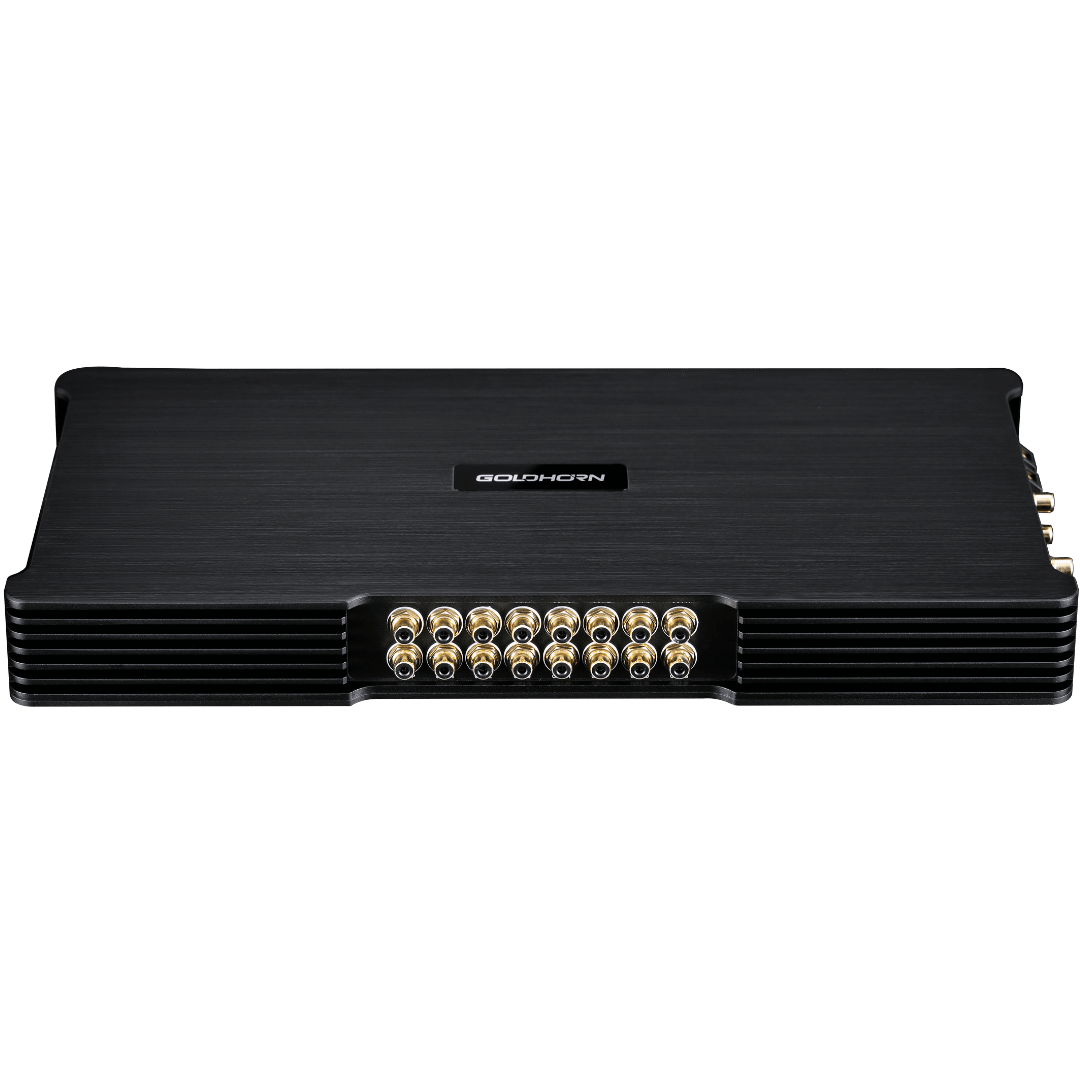
Goldhorn AB218
Flagship A²B DSP Amplifier featuring 2x ADAU1463 DSP chips, offering 12x 50W + 4x 100W output for complex multi-channel audio setups.
View ProductEliminating Copper Weight with A²B Digital Bus Technology
Developed by Analog Devices, A²B (Automotive Audio Bus) is a high-bandwidth digital bus capable of transmitting 32 channels of 24-bit/48kHz digital audio, control data, clock, and power over a single, lightweight unshielded twisted pair (UTP) cable. By interfacing directly with the vehicle's native A²B network (found in modern vehicles like Ford, BMW, Hyundai, and Mercedes), Goldhorn's AB212 and AB218 bypass the need for thick, multi-channel analog wiring harnesses.
Instead of running multiple heavy copper cables throughout the cabin, a single, featherweight UTP wire transmits the pristine digital signal directly from the vehicle's head unit to the Goldhorn amplifier. This eliminates up to 75% of the wiring weight, reduces harness bulk, and prevents electromagnetic interference (EMI) which is highly prevalent in EV high-voltage environments.
Advanced DSP Control and Power Management
Furthermore, Goldhorn's integrated DSPs allow for surgical precision in acoustic tuning. By utilizing the built-in ADAU1463 chips, installers can program steep active crossover filters, 31-band parametric equalizers, and precise time alignment. This level of control ensures that every watt of Class-D power is optimized for the specific vehicle cabin acoustics, preventing wasted amplifier energy and delivering crystal-clear, high-end sound quality without taxing the auxiliary battery system.
Conclusion: The Future of Eco-Friendly Car Hi-Fi
Upgrading your electric vehicle's audio system does not have to mean sacrificing its environmental efficiency or driving range. By selecting high-efficiency Class-D amplification and leveraging digital bus systems like A²B, Goldhorn's AB212 and AB218 DSP amplifiers provide the perfect equilibrium. They eliminate kilograms of heavy copper runs, minimize power consumption on the auxiliary 12V/16V rail, and deliver a breathtaking, audiophile-grade soundstage that is perfectly tuned to your EV's cabin.