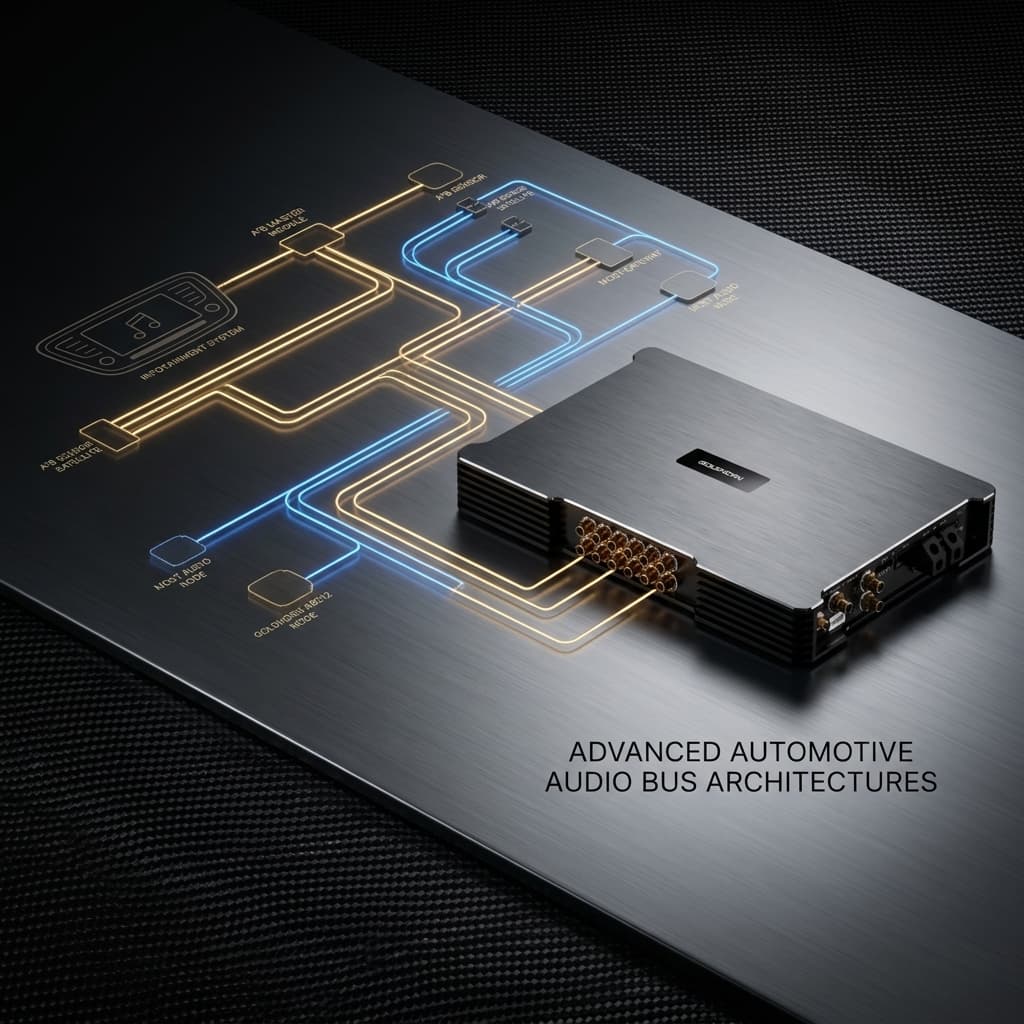
Upgrading a premium car audio system has never been more complex. The days of simply tapping into analog speaker wires behind the dashboard are fading. Modern automotive manufacturers have moved toward high-speed digital networks to route audio, control signals, and vehicle data. Two technologies dominate this space in premium vehicles: the older MOST (Media Oriented Systems Transport) bus and the newer, revolutionary A²B (Automotive Audio Bus) by Analog Devices.
For car audio installers and audiophiles, understanding these networks is crucial. A mistake can trigger vehicle fault codes, disable safety warning chimes, or degrade signal quality. In this article, we will compare MOST and A²B networks in terms of bandwidth, latency, topology, weight, and explain how Goldhorn’s integration solutions bridge both worlds.
1. What is the MOST Bus? The Optical Pioneer
Developed in the late 1990s, the MOST bus was the first widespread standard for high-bandwidth automotive infotainment networks. It is most commonly found in European premium vehicles, including older BMWs, Audi, Porsche, Mercedes-Benz, Land Rover, and Volvo.
MOST is a ring-topology network. Data is transmitted sequentially from one node to the next in a closed loop. The physical layer typically utilizes **Plastic Optical Fiber (POF)** (known as MOST25 and MOST150) or coaxial copper cables. The optical fibers transmit digital audio via light pulses, making the network completely immune to electromagnetic interference (EMI).
However, MOST has several distinct disadvantages:
- Ring Vulnerability: Because it is a ring network, if a single node (like a factory amplifier or CD changer) fails or is disconnected, the entire loop breaks, causing the infotainment system to shut down.
- Physical Fragility: Fiber-optic cables cannot tolerate sharp bends. If bent past their minimum radius, the glass/plastic core cracks, scattering the light signal and breaking the bus connection.
- High Cost: The optical transmitters, receivers, and specialized connectors are expensive to manufacture and require precision tools to repair or splice.
- No Power Delivery: Optical fiber cannot carry electrical power. Every node requires its own separate power and ground connections.
How to Upgrade MOST Bus Systems: MOST Interfaces
If you are upgrading an older luxury vehicle with a MOST bus, you cannot simply splice into the system. Instead, you need a digital bridge that can join the fiber-optic ring, act as a valid network node, and extract the pure digital audio stream.
A digital MOST integration interface (such as a fiber-optic to Toslink converter) is specifically designed for this purpose. These interfaces perform a jitter-free, lossless conversion from MOST optical signals to a clean digital output. This allows you to route a pure digital signal to your external processor or amplifier, all while fully retaining factory features like parking sensors, navigation prompts, and steering wheel controls.
2. What is the A²B Bus? The Lightweight Revolution
Introduced by Analog Devices, the **Automotive Audio Bus (A²B)** is the modern successor to older digital networks. It is designed to meet the demands of modern electric vehicles (EVs) and smart cabins, where weight reduction and real-time processing are paramount. Today, A²B is used by manufacturers like Tesla (Model 3/Y/S/X), Ford (B&O systems), Hyundai/Kia, BYD, Zeekr, and XPeng.
Unlike MOST, A²B uses a **line or daisy-chain topology**. A single master node (the head unit) controls up to 14 slave nodes in a sequential line. The physical medium is a single **Unshielded Twisted Pair (UTP)** copper wire, which carries audio, control data, I2C commands, and clock synchronization.
A²B offers major advantages:
- Extremely Low Latency: A²B has a fixed, deterministic latency of less than 50 microseconds (0.05 ms). This is critical for Active Noise Cancellation (ANC) and Road Noise Cancellation (RNC) systems, where anti-phase waves must be generated in real-time to cancel cabin noise. MOST networks have variable latency that is too slow for effective ANC.
- Massive Weight and Space Savings: A²B reduces cabling weight by up to 75% compared to traditional analog wiring harnesses and heavy fiber-optic cables. This directly improves EV driving range.
- Phantom Power over Bus: The UTP cable can carry up to 300 mA of current to power slave nodes directly, eliminating separate power runs for remote microphones and sensors.
- High Bandwidth: A²B supports up to 32 channels of 24-bit/48kHz audio bidirectionally, allowing the car to manage multiple microphones, voice assistants, and speaker channels simultaneously.
Upgrading Native A²B Systems: Goldhorn A2B DSP Amplifiers
Modern EVs and vehicles equipped with A²B cannot be upgraded using traditional line output converters (LOCs) without disabling the Active Noise Cancellation (ANC) or triggering error codes. The solution is native A²B integration.
Goldhorn’s AB212 and AB218 are industry-leading A²B-native DSP amplifiers. They connect directly to the vehicle's digital A²B bus via plug-and-play wiring harnesses.
- The AB212 features a single Analog Devices ADAU1463 DSP chip and provides 8x 50W + 4x 100W of Class D power output, making it perfect for select Tank and BYD models.
- The flagship AB218 features dual ADAU1463 DSP chips, delivering a massive 12x 50W + 4x 100W output, tailored for high-end multi-channel systems in vehicles like BYD, Li Auto, and XPeng.
3. Direct Comparison: MOST vs. A²B
To summarize the core differences between these two digital audio bus technologies:
| Parameter | MOST Bus (MOST25 / MOST150) | A²B (Automotive Audio Bus) |
|---|---|---|
| Physical Medium | Plastic Optical Fiber (POF) or Coax | Unshielded Twisted Pair (UTP) Copper |
| Network Topology | Ring Topology (Single loop) | Daisy-Chain / Line Topology |
| Latency | Variable, higher latency | Fixed, deterministic (< 50 microseconds) |
| Active Noise Cancellation (ANC) Support | No (Latency is too high/variable) | Yes (Native support for real-time ANC/RNC) |
| Cabling Weight & Cost | Heavy, rigid, expensive fiber-optic | Ultra-lightweight, flexible, low-cost UTP |
| Power over Cable | No (requires separate power wires) | Yes (phantom power up to 300 mA) |
| Max Audio Channels | Limited (typically 15-60 depending on spec) | Up to 32 channels bidirectional (24-bit/48kHz) |
Conclusion: Navigating Your Audio Upgrade
Whether your vehicle is equipped with the robust optical ring of the MOST bus or the ultra-lightweight daisy-chain of the A²B network, upgrading your system does not mean sacrificing OEM functionality. By choosing the correct integration hardware—whether it is a digital MOST integration interface for MOST-based European classics or a native Goldhorn A2B DSP amplifier (AB212 or AB218) for modern electric and smart vehicles—you can unlock audiophile-grade performance without compromise.